
Research and publications
Environmental Dashboard began as research at Oberlin College on feedback: what people do when they can see the energy and water they use. These are our papers.
Featured papers
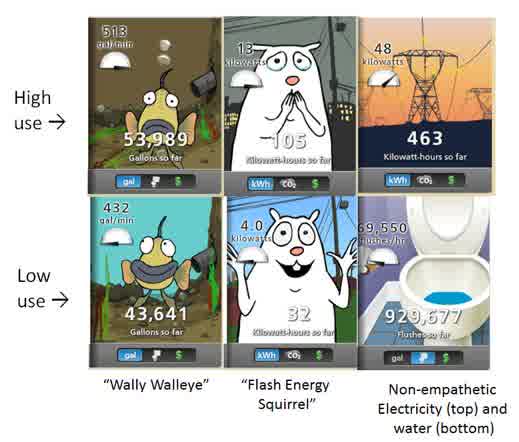
Petersen, J.; Frantz, C.M. (in press), Sustainability (in press)
Translating Data into Feelings: Empathetic Character Gauges Transform Real-Time Electricity and Water Use into Emotions Designed to Motivate Conservation
Studies examine how people interpret character gauges, respond emotionally to resource use and connect with nature.
Kearney, B.; Petersen, J.E.; Frantz, C.M. (2025), Sustainability 17(22), 10318
Overcoming Pluralistic Ignorance: Brief Exposure to Positive Thoughts and Actions of Others Can Enhance Social Norms Related to Climate Action and Support for Climate Policy
People underestimate how much others care. For 969 people, a short look at Community Voices made climate action feel normal.
Petersen, J.E.; Frantz, C.M. (2024), Sustainability 16(17), 7312
Changing culture through pro-environmental messaging delivered on digital signs: A longitudinal field study
After two years of screens in six places, people of color reported stronger green norms, residents felt more connected to their town and its nature, and more said they save electricity.
Frantz, C.M.; Petersen, J.E.; Lucaites, K. (2021), PLOS ONE
Novel approach to delivering pro-environmental messages significantly shifts norms and motivation, but children are not more effective spokespeople than adults
Community Voices raised concern, perceived norms and commitment to act. Children were no more persuasive than adults.
Petersen, J.E.; Frantz, C.M.; Tincknell, E.; Canning, C. (2018), Systems Research and Behavioral Science
An animated visual representation of real-time resource flows through a community enhances systems thinking
Citywide Dashboard improved systems thinking for students initially less connected to nature. Brief exposure also widened adults' view of cause and effect.
Clark, S.; Petersen, J.E.; Frantz, C.M.; Roose, D.; Ginn, J.; Rosenberg-Daneri, D. (2017), PLOS ONE
Teaching systems thinking to 4th and 5th graders using Environmental Dashboard display technology
Dashboard lessons improved content retention and systems thinking in six classes. Passive exposure alone had no measurable effect.
Petersen, J.E.; Rosenberg-Daneri, D.; Frantz, C.; Shammin, Md R. (2017), Springer (book chapter)
Environmental Dashboard: Fostering pro-environmental and pro-community thought and action through feedback (chapter, Handbook of Theory and Practice of Sustainable Development in Higher Education)
Feedback at three scales: a building, a town's resource flows, and neighbors' words.
Petersen, J.E.; Frantz, C.M.; Shammin, Md R.; Yanisch, T.M.; Tincknell, E.; Myers, N. (2015), PLOS ONE
Electricity and water conservation on college and university campuses in response to national competitions among dormitories: Quantifying relationships between behavior, conservation strategies and psychological metrics
In 2010, dorms cut electricity 4% and water 6%; the top tenth cut 28% and 36%. Saving tracked dashboard visits.
Petersen, J.E.; Frantz, C.; Shammin, M.R. (2014), Solutions 5(1):79-87
Using sociotechnical feedback to engage, educate, motivate and empower environmental thought and action
The framework behind every screen: get attention, explain, motivate, then make acting easy.
Petersen, J.E.; Shunturov, V.; Janda, K.; Platt, G.; Weinberger, K. (2007), International Journal of Sustainability in Higher Education 8:16-33
Dormitory residents reduce electricity consumption when exposed to real-time visual feedback and incentives
Electricity fell 32%. Dorms with live feedback cut 55%, against 31% with weekly readings.
More publications
- Jauernig, J.; et al. (incl. J. Petersen) (2026). Perspective taking through model building: A path to open-mindedness and de-polarization?. Journal of Positive Psychology. Read the paper: Perspective taking through model building: A path to open-mindedness and de-polarization? (opens in a new tab)
- Frantz, C.M.; Blotner, J.; Petersen, J.E. (2025). How do we measure and increase systems thinking? Comparing self-reported and performative metrics in response to building causal loop models. Systems Research and Behavioral Science. Read the paper: How do we measure and increase systems thinking? Comparing self-reported and performative metrics in response to building causal loop models (opens in a new tab)
- Jordan, R.; Gray, S.; Sorensen, A.; Frantz, C.M.; Brehm, P.; Shammin, M.; Petersen, J.E.; Boyse-Peacor, A.; Jauernig, J. (2025). Comparing measures of systems thinking in a post-secondary classroom. Journal of Education and Practice 16(12). Request the paper: Comparing measures of systems thinking in a post-secondary classroom (opens your email app)
- Jordan, R.C.; Gray, S.; Boyse-Peacor, A.; Sorensen, A.E.; Frantz, C.M.; Jauernig, J.; Brehm, P.; Shammin, Md R.; Petersen, J. (2023). Promoting systems thinking through perspective taking when using an online modeling tool. Frontiers in Education 8. Read the paper: Promoting systems thinking through perspective taking when using an online modeling tool (opens in a new tab)
- Trencher, G.; Rosenberg-Daneri, D.; McCormick, K.; Terada, T.; Petersen, J.; Yarime, M.; Kiss, B. (2016). The role of students in the co-creation of transformational knowledge and sustainability experiments: Experiences from Sweden, Japan and the USA (chapter, Engaging Stakeholders in Education for Sustainable Development at University Level). Springer (book chapter). PDF (Drive): The role of students in the co-creation of transformational knowledge and sustainability experiments: Experiences from Sweden, Japan and the USA (chapter, Engaging Stakeholders in Education for Sustainable Development at University Level) (opens in a new tab)
- Rosenberg-Daneri, D.; Trencher, G.; Petersen, J. (2015). Students as change agents in a town-wide sustainability transformation: The Oberlin Project at Oberlin College. Current Opinion in Environmental Sustainability 16:14-21. PDF (Drive): Students as change agents in a town-wide sustainability transformation: The Oberlin Project at Oberlin College (opens in a new tab)
- Cook, T.; Shammin, M.R.; Frantz, C.; Petersen, J.E. (2014). Measuring Transition to Sustainability: From Simple Diagnosis to Data-driven Interventions. Solutions 5(1):70-78. PDF (Drive): Measuring Transition to Sustainability: From Simple Diagnosis to Data-driven Interventions (opens in a new tab)
- Shammin, M.R.; Petersen, J.E.; Suter, J. (2011). Cooling off a warming planet: Analyzing the tradeoff in policies for climate change. A case on US climate policy and politics for use by environmental educators. National Center for Case Study Teaching in Science. PDF (Drive): Cooling off a warming planet: Analyzing the tradeoff in policies for climate change. A case on US climate policy and politics for use by environmental educators (opens in a new tab)